This article is written for two different people in your business, and each reads it through a different lens shaped by what they're accountable for. Whether you're the one deciding whether to sign the renewal, or the one who'll have to work out what comes next, we've marked out the sections built for each, so you can go straight to what matters to you instead of reading the whole thing end to end.
Decision-makers
If you own this decision on the P&L (owner, CFO, general manager), follow the orange dot (●) through this article. We've marked the sections below with one, since they carry the figures and the judgment call without needing a technical background to make sense of them:
Technical influencers
If you'll be the one evaluating or running any change (IT manager, operations lead), follow the blue dot (●) instead. The sections below are marked with one, and they're the ones worth your time first:
Either way, every section stands on its own, so read the rest whenever it's useful rather than out of obligation.
Know someone who's about to sign a VMware renewal without asking these questions first? This is the one worth forwarding.
Overview
Most businesses don't choose to leave VMware. They get pushed. And they don't notice the push until the invoice arrives.
For years, VMware was simply the safe choice. Reliable, well understood, the default answer to 'what do we virtualise on?' Nobody got fired for buying VMware. That calculation has changed, not because the technology got worse, but because the business behind it did.
The conversation nobody's had yet
There's a conversation happening in a lot of Australian businesses right now, except it hasn't actually happened yet. The IT manager has seen the renewal number. They know it's higher, maybe a lot higher, than last time. They haven't taken it to the owner or the CFO yet, because they're not entirely sure how to explain why, or because they're hoping the number might come down before they have to.
Meanwhile, the owner already suspects something's coming. Vague headlines about VMware pricing, a comment from a peer at another business, a feeling that IT costs never seem to go down. Both sides are bracing for a number neither of them has said out loud yet.
If that sounds familiar, you're not behind. You're just about to have a conversation that thousands of other Australian businesses are having this year, too.
What actually changed
In 2023, Broadcom acquired VMware. Since then, the commercial model has been rebuilt from the ground up. Perpetual licences, the kind where you bought it once and owned it, have been phased out in favour of mandatory subscriptions. The individual products businesses used to buy separately, the hypervisor on its own, just vSphere, are gone. Now it's bundles, packaged with networking and management tools many SMBs never asked for and don't use.
Then there's the minimum purchase requirement. Broadcom's licensing now requires a minimum core count per order, regardless of how small your actual environment is. A business running a modest single server can find itself licensing far more capacity than it will ever touch, simply because that's the smallest unit now sold. It's a bit like being told the smallest car you're allowed to buy is a minibus, because that's what the manufacturer decided to make.
None of this is a rumour or a worst-case scenario. It's the current commercial reality for anyone renewing.
The numbers
Here's what that looks like in practice.
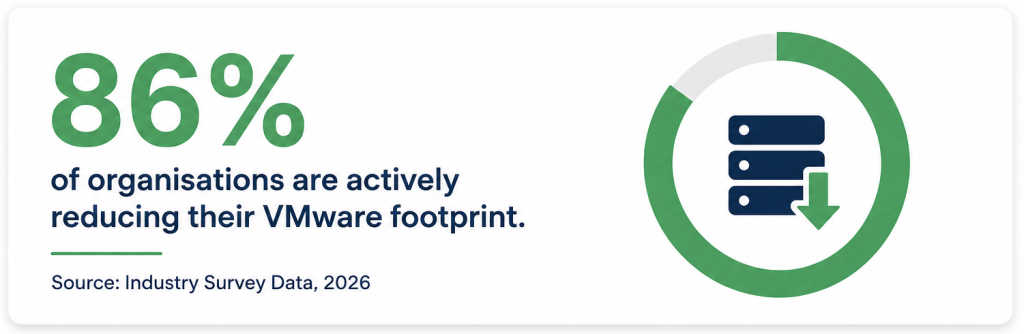
That's not a fringe reaction. That's the clear majority of the market responding to the same pressure.
'Reducing footprint' doesn't always mean a full exit in one move. For most of that 86%, it's a gradual shift: new workloads are built on platforms other than VMware by default, ageing hosts are replaced with alternative platforms as they reach end of life, and the VMware estate shrinks steadily rather than disappearing overnight. It's a managed retreat, not a scramble, which is exactly the kind of change a business can plan around rather than be forced into.
The other figure worth sitting with is the 88% who remain concerned about future pricing, a wider group than the 86% already acting. That gap matters. It means even organisations not yet reducing their footprint don't expect the pricing pressure to ease; they're earlier in the same process. This isn't being treated as a one-off shock to absorb and move past. It's being read, fairly consistently, as a new and ongoing cost trajectory.
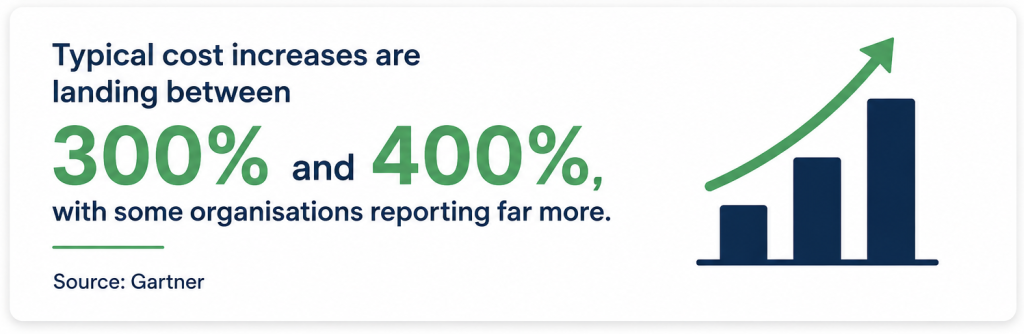
According to a report CISPE (the European Cloud Industry Association) submitted to the EU Commission, renewal increases in the cases it examined ranged from 800 to 1,500%. Numbers at that scale stop looking like a price rise and start looking like a different business relationship altogether.
The range is wide because two separate changes are compounding at once, not one. The first is bundling: what used to be purchased as a standalone hypervisor licence now comes packaged with software-defined storage and networking components, whether or not a business uses either. The second is the shift from perpetual to subscription licensing itself. A cost that used to land once every five to seven years, timed to a hardware refresh, now lands every single year as a recurring subscription. Businesses comparing ‘last year's renewal’ to 'this year's renewal' are often unknowingly comparing two different pricing models, not just two different prices.
That's also why the increase isn't uniform. Where an organisation sits on that spectrum depends on its existing tier, its region, and how much of the newly bundled capability it already needs. What's consistent across almost every case is the direction. Nobody examining this data set is reporting a decrease.
'The 72-core floor and bundled VCF are how a vendor tells SMBs they're no longer the customer.'
Source: Communicat, Australia
That's how one Australian commentator described the shift, and it's a fair read. The pricing structure itself is the message. It's not built for a 20-seat business anymore, and increasingly, it doesn't pretend to be.
Here's what that looks like in practice. A business running two modest hosts, say 16 cores each, has 32 cores of actual infrastructure. Under the current minimum, it still licenses for 72 cores, more than double what it owns or will ever use. That gap isn't a rounding error in the pricing; it's the structure working exactly as designed, just designed for a much larger buyer.
The bundling compounds it further. The current commercial packaging combines the hypervisor with software-defined storage and networking components as a single, mandatory purchase. A business that already has its own storage arrangement or a simple, working network setup still pays for the bundled alternative, since there's no longer an option to buy the hypervisor separately. For a 20-seat business, that's not enterprise-grade capability being made available. Its enterprise-grade cost is being made unavoidable.

A rough example
We recently worked through this exact scenario with a business running around 40 virtual machines, a fairly typical mid-sized environment. Under the old model, their renewal was a known, budgeted cost. Under the new one, the same environment is priced at several times that figure, largely because of bundling and core minimums rather than anything to do with how they actually use the platform.
They hadn't changed. The bill had.
In fairness to VMware
It's worth being honest about the other side of this. Some businesses genuinely rely on VMware's more advanced enterprise features, deep integrations, specific certifications, and the tooling their teams have used for a decade. Retraining has a real cost, and so does the uncertainty of moving off a platform you know works.
Nobody should switch platforms just because switching is trendy. The businesses making this move well are the ones asking a specific question: Are we actually using what we're now being asked to pay for? For many SMBs, the honest answer is no.
Where the shift is heading
Quietly, and without much noise, a lot of that shift is landing on Proxmox. It's not a like-for-like clone of VMware, and nobody seriously claims it is. But for the large majority of SMB workloads, virtualising servers, running core business applications, keeping things backed up and highly available, Proxmox covers somewhere in the order of 90 to 95% of what VMware was actually being used for day to day. The gap tends to sit in enterprise-scale features that most 20 to 200-seat businesses were never using in the first place.
That's the quiet part of 'quietly moving off VMware.' It's not a dramatic rip-and-replace story. It's businesses realising the platform doing the heavy lifting doesn't need to be the most expensive one on the market.

The migration question
The idea of migrating tends to sound worse than it actually is. Modern migration tooling has matured significantly, and a well-planned move can happen with far less disruption than most people expect when walking in. It's not a weekend project done casually, but it's also not the multi-month, high-risk undertaking it might sound like from the outside. When done properly, with a clear plan for which moves to make and when, most businesses come out the other side with less drama than the renewal conversation itself.
Three questions worth asking before any vendor renewal
This isn't really only a VMware problem. It's worth building a habit around any major vendor renewal, not just this one.
- Are we paying for capability we're actually using, or capability we were sold.
- Has the commercial relationship changed since we last signed, not just the price.
- If we did nothing and just renewed, would that be a decision, or just a default.
Worth revisiting the next time any long-standing vendor contract comes up for renewal, whatever it happens to be.
Where this leaves you
The businesses that come out ahead here aren't the ones with the best IT team. They're the ones who asked the question early, before the renewal deadline was forcing their hand.
VMware isn't really the story. The story is what happens to any business when a critical piece of infrastructure is controlled entirely by someone else's pricing decisions. This time it's a hypervisor. It won't be the last vendor relationship worth questioning.
If your renewal is coming up, or you're just not sure whether your current setup still makes sense, a free VMware cost review is a straightforward, no-pressure way to find out.
Talk to Next Step about what you're running, and we'll come back with what your options actually look like, no obligation either way.