
Security That Doesn't
Rely on You Noticing First
Next Step delivers layered cyber defence built for Australian businesses without a dedicated security team, without the fear-based sales pitch.

Security Shouldn't Feel Like a Threat.
Good cybersecurity is quiet. It closes gaps before they're found
by someone who isn't on your side.
Layered Defence, Not a Single Point of Failure.
For businesses without a dedicated security team, the gap between the threats out there and the protection actually in place is often wider than anyone realises.
And when too much depends on too little protection, the cost of finding out the hard way is real.
Next Step builds security in layers: monitoring, response, identity and compliance working together, so no single gap becomes the whole story.
Let’s Secure a Meeting to Discuss Cyber
What We Cover
From Essential 8 compliance and 24/7 monitoring to penetration testing, incident response and identity management, this is the full scope of what’s included:

Essential 8 Compliance
A clear, mapped path to Essential Eight maturity for your environment

MDR
Managed Detection and Response, watching for threats around the clock.

Security Operations Centre (SOC)
A dedicated team monitoring for the things automated tools miss.

vCISO & GRC Advisory
Senior security leadership, without a full-time hire.

Incident Response
A plan and a team ready before an incident happens, not after.

Penetration Testing & Red Team
Your defences tested the way an attacker actually would.

EDR/XDR
Endpoint threats are detected and contained before they spread.

Vulnerability Management
Weaknesses found and closed on a schedule, not by accident.

Identity & Access Management
The right people with the right access, and nobody else.

Data Protection
Your information is safeguarded at rest and in transit.

Security Awareness Training
Has turned your team into a defence rather than a weak point.

24/7 Security Monitoring
Someone is watching every hour of every day.
Built to a Standard, Not a Guess
Next Step's security stack includes Essential Eight Maturity Level 2-aligned management, managed detection and response, and vulnerability monitoring across all in-scope endpoints.
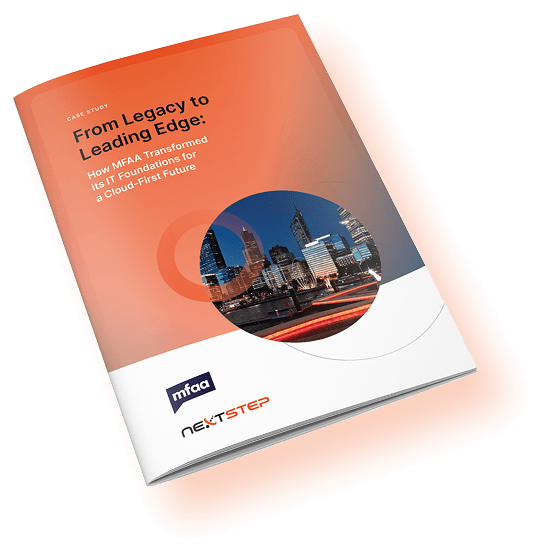
CASE STUDY: MFAA
From Legacy to Leading Edge
MFAA moved off legacy, on-premise infrastructure to a secure, cloud-first environment under Next Step’s management: cloud migration, a standardised device environment, and Essential Eight-aligned cybersecurity, delivered as one connected project rather than three separate ones.

If you do not have the IT operations and foundations in place and working well, it becomes much harder to focus on broader organisational priorities.
The value for MFAA is that we now have a more secure, reliable and modern technology environment, and we have confidence that Next Step is managing those foundations effectively.
Evan Thomas
COO, MFAA

Proportionate to Your Actual Risk.
Security is scoped to what your business actually needs to protect, not sold as a fixed bundle regardless of your risk profile.

Assess.
We map your actual exposure in plain language.

Close the highest-risk gaps first,
not the easiest ones.

Monitor continuously,
under one agreement.
Thirty Years Deep
Next Step has been doing this since 1994. The tools have changed. The commitment to getting it right hasn’t.

Why Businesses Choose Next Step
Full Ownership, Not Just Advice
One team, one relationship, one number to call. We manage your vendors, contracts, and environment so nothing falls through the cracks between suppliers.
Reporting You Can Actually Act On
Technology risk and investment translated into plain language, not technical jargon, so decisions get made with confidence.
Response Times You Can Hold Us To
Every incident is logged, prioritised and worked to a committed target, not a best guess.
Forward Planning as Standard
Every client gets a technology roadmap. You'll always know what's coming, what it costs, and why it matters, before it happens.
FAQs
What is the Essential Eight, and does my business need to comply with it?
The Essential Eight is a cybersecurity framework developed by the Australian Signals Directorate, outlining eight baseline strategies to reduce cyber risk. It isn’t mandatory for most businesses yet, but insurers and regulators increasingly reference it.
How do we manage cybersecurity without a dedicated security team?
Most businesses manage cybersecurity through a managed provider rather than internal staff. A layered approach, endpoint detection, monitoring, identity controls and awareness training, covers the gap without a full-time hire.
What's the difference between MDR and a SOC?
MDR (Managed Detection and Response) is the monitoring and response service itself. A Security Operations Centre is the team and infrastructure behind it, watching for the things automated tools miss.
What happens if we have a security incident?
Incident response starts with a plan and a team ready before an incident happens, not scrambled together after, so containment starts immediately and the business keeps running through it.
Is cybersecurity affordable for a business our size?
Yes. Security is scoped to your actual risk profile, not sold as a fixed bundle regardless of size, so smaller businesses aren’t paying for enterprise-scale coverage they don’t need.
What's the difference between EDR and XDR?
EDR (Endpoint Detection and Response) watches individual devices for threats. XDR (Extended Detection and Response) extends that visibility across endpoints, network and cloud, correlating signals that a single-layer tool would miss on its own.
What is a vCISO and do we need one?
A vCISO, or virtual Chief Information Security Officer, provides senior security leadership and governance without a full-time executive hire. It suits businesses that need strategic security direction but don’t have the scale to justify a permanent role.
How often should penetration testing be done?
Most businesses benefit from penetration testing at least annually, and after any significant change to systems or infrastructure, so defences are tested against how the environment actually looks today.
What is vulnerability management and how is it different from a one-off scan?
A one-off scan gives a single snapshot. Vulnerability management is ongoing: weaknesses are identified, prioritised and closed on a regular schedule, so new exposures don’t sit unaddressed between scans.
Do we need cybersecurity insurance as well as managed security?
The two work together rather than replace each other. Insurers increasingly expect evidence of active security measures, and managed security reduces both the likelihood of a claim and the premium in many cases.
What is identity and access management and why does it matter?
Identity and access management controls who can reach what inside your environment. Most breaches involve compromised credentials, so making sure the right people have the right access, and nobody else, closes one of the most common entry points.
How quickly will we know if there's a breach?
With 24/7 monitoring and managed detection and response in place, threats are typically identified and contained within hours, rather than discovered weeks later through irregular activity.
Talk to Someone Who'll Give You a Straight Answer
No sales script, no pressure to sign today.
Just a clear picture of where your IT stands and what fixing it would actually involve.